Prompt: Another aspect of our being enmeshed in technological devices and interfaces involves are attention and ability to focus it. Reflect on your ability to focus in relation to social media and the like.
Social media has revolutionized the way we give our time and attention to those around us. For most of mankind’s history, interactions were primarily engaged in person or by letter. What distinguishes these two means of communication from modern technology, such as social media, is the attention each person is given. When exchanging information and ideas with someone, there is an underlying assumption that attention needs to be given to one another for the conversation to have any meaning and progress in any manner. If I am dialoguing with my classmate and “tune out” for even a few seconds, it will make it difficult, if not impossible, for me to comprehend and engage with the information and thereby contribute to the conversation. As such, we have—through in-person communication—consistently trained ourselves to focus on the individual and/or object in front of us. Similar things can be said when it comes to written communication, such as a letter. Unlike a text, picture, blog post, and the like, a letter, once sent, cannot be edited or altered in any fashion. There is a “permanence” to the letter; it says what it says whether you like the content therein or not. Moreover, like a conversation, if there is to be any meaningful communication, focus on the letter itself must be given. If one attempts to skim through the letter, it is almost guaranteed that valuable information will be missed and/or not understood properly.
A commonality between a conversation and a letter is a healthy pace. This pace is not always realized, but there is a natural pace and degree to which one engages in the conversation as ideas and information are exchanged. Social media utterly disrupts this with an ever-changing environment, fast-paced conversations, overwhelming amounts of choices, and at times, ridiculous amounts of information. Digital platforms, such as social media, “constantly tweak their interfaces and rules to attract and retain as many users as possible.”1 Unlike an in-person conversation or a letter, social media is something that we can access as we please; we are “the master.” Reels have made this very apparent: if a piece of content doesn’t capture one’s attention within the first few seconds, they dismiss the person and anything they have to say. This may seem irrelevant but given the excessive amount of time that people spend on social media,2 it becomes apparent that our ability to focus on a single person or task is diminished. There is an untold number of accounts, posts, videos, communities, and threads that people have the option to access or choose from. It is virtually impossible to have a singular focus on such a platform when several other options are demanding your attention. Notifications illustrate this “demand” perfectly, but more will be said on that later.
When it comes to conversing with others on social media, we are bestowed with a power that is not present in the other two modes of communication: “swiping” and “blocking.” Built within social media platforms (such as TikTok) is the swiping (also referred to as “doom scrolling”) mechanism. Effectively, you are the arbiter as to what kind of content you watch, from whom, the amount you watch, and when it’s time to stop. By one swipe of our finger, we quickly dismiss a person and what they have to say; this leads us to view people as less than human. In other words, people become pieces of content to consume or reject as they desire. If one is severely dissatisfied, they can block someone. Effectively, you erase that person from your life and prevent them from communicating with you; the other party cannot override this decision. Social media puts us at the center of a conversation; we can be surrounded by people who echo what we want to hear, and those who do not conform will be “excommunicated.”
It is precisely because of the self-centeredness of social media that we are seeking gratification from it. Because of this desire, we want to focus on the object (namely, social media) that will give us pleasure. Yet, in this desire for consistent gratification, we are overloaded with the endless amount of stimulation that social media offers. Now, it must be noted that social media does have a great deal of benefits, education being one of them. However, this does not mean that there is not an improper use of it. Based on my own experience, we all ought to spend less time on social media; this will improve our physical and mental health.
The author does not consistently use social media, but this was not always the case; a four-hour TikTok session comes to mind, as do many other hours that were wasted staring at a screen. When spending excess time on social media, I noticed that during actual conversations (conversations on social media do not count) my eyes would dart from one thing to another, as if I could not keep my eyes on the person (or “target”) in front of me. Moreover, I had less stamina for extended conversations that required depth in my replies and intentional listening. Social media provides an unorthodox and unnatural approach to communication as a whole, a far cry from the traditional and (I’d argue) proper way of conversing with one another. The amount of attention that our generation can give to a singular task at a given time is concerning, considering social media use isn’t decreasing. As previously mentioned, social media is not limited to the active usage of the app itself. Notifications open up access to the user in their everyday lives. Some people are eagerly waiting for the next notification to appear to justify their repeated use of social media. This anticipation draws focus away from the real world and the people in front of them.
The repeated use of social media on a cellular device also engrains the habit of being on one’s phone. Such mindless scrolling lacks any focus, goal, or end in sight; in other words, it’s meaningless. And, if it’s meaningless, why pay attention to it? Yet, this is not the conclusion we come to when we are talking with others or engaging with material they have written. We understand that we are not at the center and that there are things and people beyond us. We must give them our time and attention to understand and interact with them.
In asking ChatGPT, “Is our attention span positively impacted by using social media?” It responded by acknowledging that there are benefits concerning our attention but conceded that social media “tends to hinder deep, sustained attention needed for tasks requiring longer focus.”3 Moreover, it also concedes that while individual experiences may vary, “[t]he idea that social media objectively hinders focus and attention span is supported by much research.”4 This statement by ChatGPT led me to seek a scholarly article in support of that claim. One peer-reviewed study notes that “attention dysregulation predicts [problematic social media use], mediated by impulsive social media use.”5 As is the habit of many, we impulsively access social media without any particular reason for doing so. These sessions may be brief or extended, but they accumulate over time. By habitually disregarding our focus on a given activity, our ability to actively focus will be “unfit.”
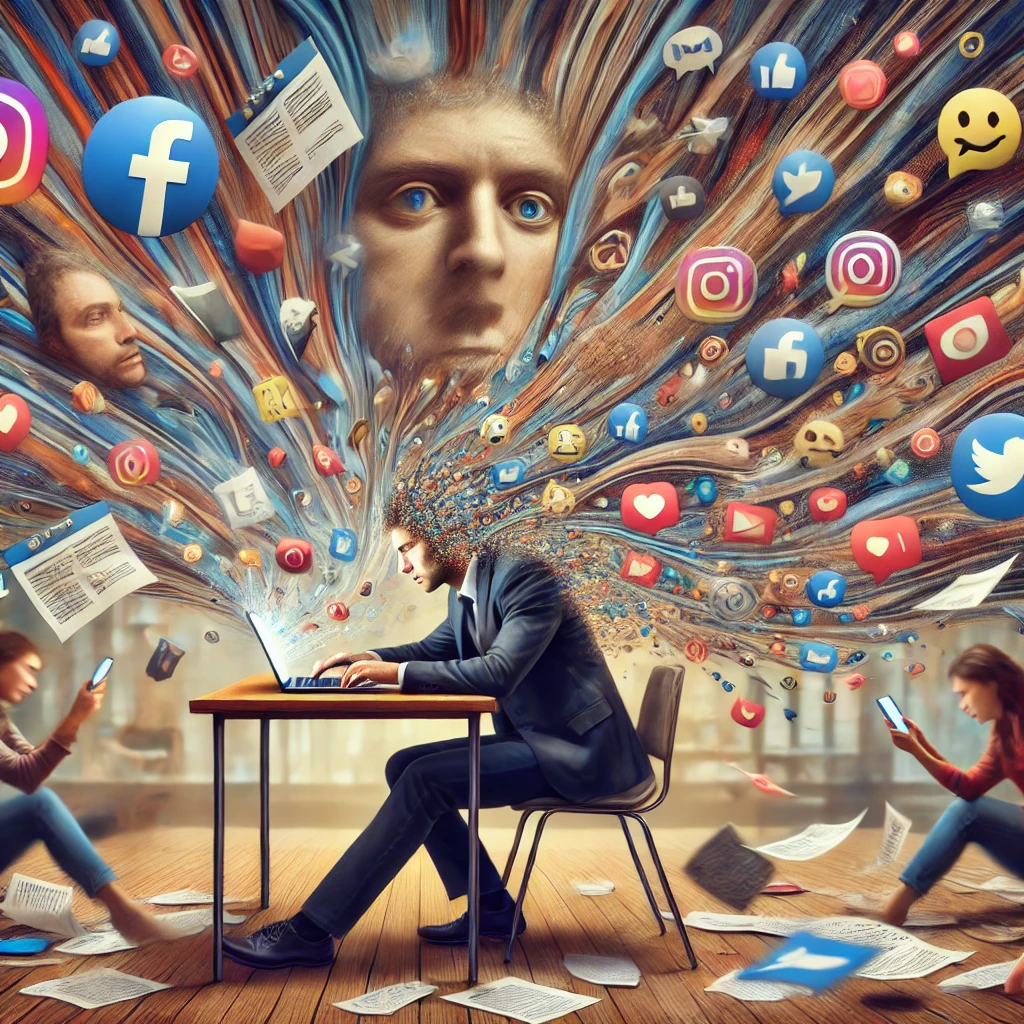
Following this, I asked ChatGPT to generate an image that captures the effect social media has on our ability to focus; I have attached the picture6 to this project below. The picture itself is overwhelming to even look at, which goes to show the damage we are doing to ourselves by actively engaging on social media. The solution is simple: use social media less. Personally, it has positively impacted my life to distance myself from the various platforms that compete for my attention. The “self” is obscured and sometimes forgotten when using social media because we play our identity in what people see, not in who we are. Breaking these shackles allows us to be human and recognize our shortcomings.
This project has aimed to illuminate a simple yet consistent issue that’s been grafted into our lives. Hopefully, this project and my experience will resonate with the reader and set them on a path of freedom, where one’s identity is not found within a profile picture or the number of views one’s TikTok gets.
- William Davies, “William Davies, the Politics of Recognition in the Age of Social Media, NLR 128, March–April 2021,” New Left Review, April 30, 2021, https://newleftreview.org/issues/ii128/articles/william-davies-the-politics-of-recognition-in-the-age-of-social-media.
↩︎ - See David Caelum Arness and Theodora Ollis, “A Mixed-Methods Study of Problematic Social Media Use, Attention Dysregulation, and Social Media Use Motives” (Fredericksburg, August 8, 2022), 1
↩︎ - “Chatgpt,” ChatGPT, accessed October 16, 2024, https://chatgpt.com/share/671057ed-de50-800b-853b-22af14d7820a.
↩︎ - “Chatgpt,” ChatGPT
↩︎ - David Caelum Arness and Theodora Ollis, “A Mixed-Methods Study of Problematic Social Media Use, Attention Dysregulation, and Social Media Use Motives,” 9
↩︎ - “Chatgpt,” ChatGPT ↩︎
Bibliography
Arness, David Caelum, and Theodora Ollis. “A Mixed-Methods Study of Problematic Social Media Use, Attention Dysregulation, and Social Media Use Motives.” Fredericksburg, August 8, 2022.
“Chatgpt.” ChatGPT. Accessed October 16, 2024. https://chatgpt.com/share/671057ed-de50-800b-853b-22af14d7820a.
Davies, William. “William Davies, the Politics of Recognition in the Age of Social Media, NLR 128, March–April 2021.” New Left Review, April 30, 2021. https://newleftreview.org/issues/ii128/articles/william-davies-the-politics-of-recognition-in-the-age-of-social-media.